The Dance of Life

The Dance of Life (1900)
.
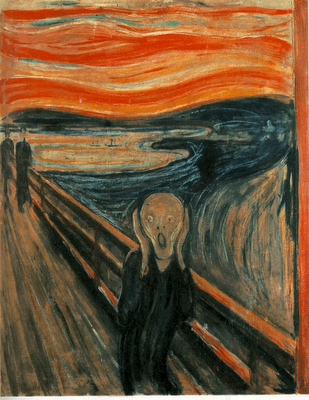
The Dance of Life takes place on a bright summer night along the shore of Aasgaardstrand in Oslo Fjord. Lit by a full moon, couples engage in an energetic dance. The phallic reflection of the moonlight in the water gives the scene a mood of sexuality. In the center of the painting, a man in a dark suit and a woman in a red dress are sunk within each other. Both of them are in the prime of their lives. The woman's dress wraps around his legs, a couple of strains of her hair reach out towards him. His eyes are closed; the two seem totally self-absorbed and oblivious of others. On the left side a young girl in a white dress and a smile on her face enters the scene. Her hand reaches out towards a flower in front of her. On the opposite side, an old woman stands in a black dress. She watches the dance of the center couple with a bitter facial expression, her hands folded in withdrawn.
One can find a very personal interpretation for The Dance of Life. Munch's first romantic experience with a cousin-by-marriage, to which Munch gave the pseudonym "Mrs. Heiberg", provided him with his own experience of the process of love. After an impassioned and joyous love affair she severed their relationship in the late 1880s. For Munch this was an emotionally painful experience, which he would struggle with for decades to come. "How deep of a mark she must have dug into my heart so that no other image can ever totally erase hers", Munch wrote in 1890 . A later love affair with Tulla Larsen, Munch found oppressive. He continually retreated from her, unable to respond to the intensity of her affection . Knowing these biographical details, one might suspect that The Dance of Life is rooted in Munch's relationships with Mrs. Heiberg and Tulla Larsen. The man in the center of the painting is Munch himself, dancing with his old love, Mrs. Heiberg. Tulla Larsen is displayed on the left wanting Munch's love and on the right side, she stands rejected by him. Munch's description of the painting in his diary supports this interpretation:
I am dancing with my true love- a memory of her.
A smiling, blond-haired woman enters who wishes to take the flower of love - but it won't allow itself to be taken.
And on the other side one can see her dressed in black troubled by the couple dancing - rejected - as I was rejected from her [Mrs. Heiberg's] dance.
As Munch was rejected by his first love, Tulla Larsen in turn is now rejected by Munch. Both of them, painted in black and turned towards each other, find themselves as partners in suffering.